
Expert articles, hospital procurement standards, and medical device innovations from Gita Mediquip.
Comprehensive guides on NABH accreditation, ICU ergonomics, and patient safety requirements.
Insights and technology updates from India's trusted hospital furniture manufacturer since 1987.
Choosing the best Hospital Bedside Locker is not a simple furniture decision. It affects patient dignity, staff efficiency, infection control, and room safety. A locker beside the bed may hold medication, glasses, water, personal devices, and fragile belongings. Its design must support real routines, not only showroom appearance.
The World Health Organization’s Global Patient Safety Action Plan 2021–2030 reports that around one in ten patients experiences harm during healthcare delivery. The report also identifies preventable harm as a major global concern. This makes cleanability, stability, and safe access important purchasing criteria. The Centers for Disease Control and Prevention recommends smooth, nonporous surfaces that can withstand regular cleaning in healthcare environments. Look closely at drawer joints, castors, handles, and the space beneath the cabinet. Dust collects there quickly. It is easy to miss.
Healthcare design researcher Dr. Roger Ulrich has stated, “The physical environment can influence patient outcomes.” His evidence-based design work supports a broader point: furniture contributes to the care experience. A suitable Hospital Bedside Locker should offer rounded edges, secure but accessible storage, a wipe-clean finish, and enough clearance for clinical equipment. Adjustable height may also reduce awkward reaching for patients and nurses.
There is no perfect locker. A highly durable model may feel heavy, while a lightweight design may move too easily. Buyers should compare cleaning protocols, load ratings, warranty terms, and user feedback from actual wards. Reports from WHO, CDC, and healthcare design research provide direction, but hands-on testing remains essential. A locker that looks excellent online can still fail beside a busy hospital bed.
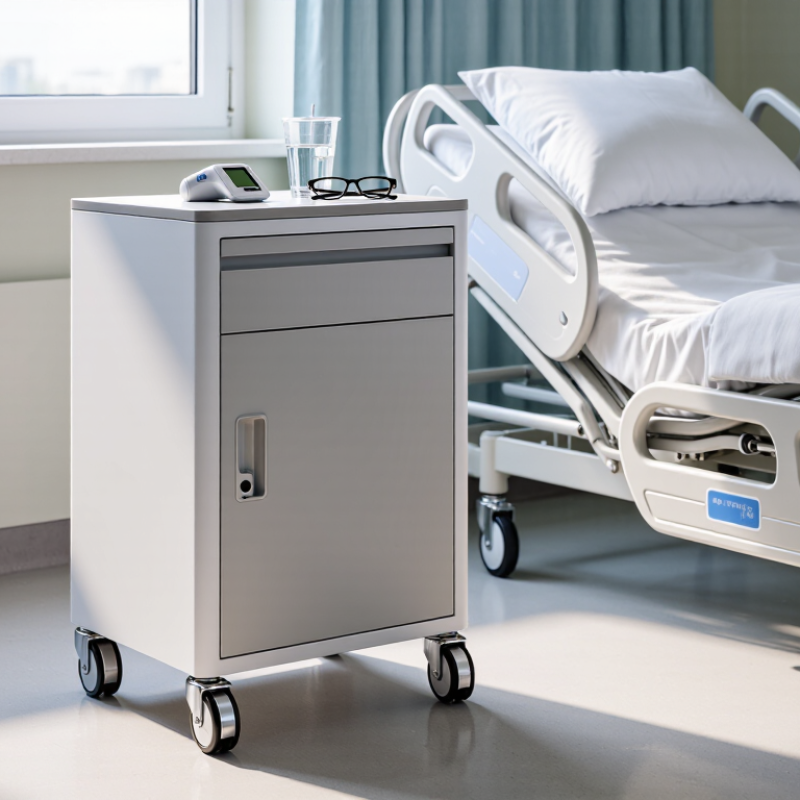
Hospital bedside lockers are not all built for the same patient or room. A standard two-door locker usually combines a cupboard, drawer, and small bedside surface. It stores clothing, medicines handled by staff, water, and personal items. An open-shelf model gives faster access, but it exposes clutter and dust. A drawer-led model offers privacy and better organization. Some units include adjustable trays, towel rails, or lockable compartments. Mobile lockers with casters can follow changing room layouts, although poorly secured wheels may move unexpectedly.
Overbed lockers serve a different purpose. They provide meals, reading space, and writing support when a patient cannot sit comfortably. Height adjustment matters for wheelchair users and patients with limited reach. Bedside cabinets with raised edges help prevent cups from sliding. Rounded corners, smooth surfaces, and sealed joints reduce cleaning difficulties. Healthcare procurement teams should check load ratings, brake quality, and compatibility with cleaning agents. These details sound ordinary. They affect daily care. Powder-coated steel is durable, while high-pressure laminate can feel warmer and quieter.
Choice should reflect patient ability, staff workflow, and available floor space. For a short-stay ward, easy-clean access may matter more than extensive storage. For long-term care, privacy, low handles, and accessible shelves deserve greater weight. Measure the room with the bed, chair, and mobility equipment in place. A locker that fits an empty room may block transfers later. That mistake is easy to make. Even a strong design needs regular inspection for loose hardware, damaged surfaces, and faulty brakes. Staff should be able to clean beneath it without moving the patient.
Choosing the best hospital bedside locker starts with patient safety, not appearance. Look for rounded edges, stable legs, and a surface that resists tipping. A secure drawer helps protect personal items, while smooth handles support patients with weak grip. The locker should also fit beside the bed without blocking staff movement, emergency access, or wheelchair transfers. Measure the available space carefully. A few centimeters can matter.
Tips: Check the locker from the patient’s viewpoint. Can a seated person reach the top safely? Are the wheels easy to lock? Does the bedside table adjust without sudden movement? Test the cleaning process, too. Seamless surfaces and moisture-resistant materials reduce hidden dirt. Ask nurses whether the drawer opens quietly during nighttime checks. Small details affect sleep and dignity.
Daily use requires practical storage. A raised edge can stop a water cup from sliding, but it may make cleaning harder. Adjustable height supports different beds, although loose mechanisms should be inspected often. I would not rely on appearance alone; a polished finish can hide weak construction. Observe the locker after repeated use, especially around hinges, casters, and joints. Record maintenance concerns honestly. Safety improves when staff, patients, and caregivers all share their experience.
A safe hospital bedside locker should support fall prevention, infection control, medication security, and reliable daily use. This practical priority score uses a 1–5 scale, where 5 indicates the feature deserves the highest attention during product assessment.
Choosing a hospital bedside locker starts with material, not appearance. WHO’s 2022 Global Report on Infection Prevention and Control estimates that 7 in 100 patients in high-income hospitals acquire at least one healthcare-associated infection. Smooth, non-porous surfaces therefore matter. High-pressure laminate, coated steel, and medical-grade polymers resist moisture and tolerate repeated cleaning. Avoid deep seams, exposed wood, and loose edge bands. They trap residue.
Storage design should support real bedside routines. A shallow top drawer can hold glasses, hearing aids, and a call device. A larger lower compartment fits clothing or personal care items. Rounded handles help patients with limited grip strength. Clearances should allow staff to clean beneath the unit. CDC environmental infection-control guidance recommends regular cleaning of noncritical equipment surfaces, yet drawers are often forgotten. That is a design failure, not only a cleaning failure.
Mobility needs careful comparison. Four smooth-rolling casters, reliable brakes, and a push handle can reduce awkward repositioning. The locker should move easily but remain stable beside the bed. Test it with one hand, while wearing gloves. It may pass a showroom test and fail beside a crowded bed. I would also check tipping resistance, wheel noise, and brake access. A few extra centimeters of storage can be useful, but excessive height may obstruct patient transfers. The best choice is not necessarily the largest one.
A hospital bedside locker should be chosen as a clinical surface, not ordinary furniture.
The World Health Organization’s 2022 global report estimates that seven in 100 acute-care patients in high-income countries acquire at least one healthcare-associated infection. In lower-income settings, the figure rises to 15 in 100. Locker design cannot eliminate this risk, but it can reduce cleaning failures.
Choose smooth, non-porous surfaces with sealed edges and minimal joints. Avoid deep handles, fabric panels, and exposed fixings. These details collect moisture, dust, and skin debris. The U.S. CDC recommends cleaning high-touch surfaces more frequently than areas with limited contact. Staff should confirm the disinfectant’s required contact time. Wiping too quickly is common. It looks clean, but the process may not be effective. A simple laminated cleaning schedule can record the date, product, and responsible worker.
Material compatibility also matters. Strong disinfectants may damage coatings, wheels, or drawer runners over time. Check manufacturer instructions before routine use. Inspect casters, hinges, locks, and drawer stops during maintenance rounds. A cracked edge should remove the locker from service, even if the damage seems minor. In practice, audits may focus on visible dirt and miss the underside of handles. That is a useful weakness to examine. A practical checklist should include hidden surfaces, drying time, and replacement triggers, not just appearance.
How to Choose the Best Hospital Bedside Locker?
A bedside locker should fit the patient, not merely the bed. For a frail patient, choose rounded edges, stable legs, and easy-grip handles. A lower top surface may reduce reaching and fall risks. For patients with limited mobility, lockable drawers can keep glasses, medicines, and personal items within safe reach. However, storage should not encourage clutter around the bed. Clear space matters.
Room conditions shape the decision. Measure the gap between the bed, wall, and visitor chair before ordering. Check door swings, bedside equipment, and cleaning routes. A compact locker suits a crowded room, while a wider unit may help long-stay patients. Smooth, sealed surfaces support frequent disinfection. Avoid deep grooves and exposed hardware. They collect dust. That detail is easy to miss.
Care requirements may change during admission. Adjustable height helps staff support different bed positions and patient needs. A removable tray can hold meals, but it must remain stable when pushed. Staff should test wheel movement on the actual floor, not only in a showroom. Noise also matters during night rounds. Quiet casters can protect sleep. Still, not every feature is essential. Extra mechanisms can fail, need training, and complicate cleaning. Ask nurses, cleaners, patients, and maintenance staff to review the sample together. Their comments may reveal a problem no specification sheet shows.
| Patient or Care Scenario | Primary Patient Needs | Room and Space Conditions | Recommended Locker Configuration | Important Specifications | Safety and Infection-Control Requirements | Selection Rationale |
|---|---|---|---|---|---|---|
| General medical or surgical patient | Accessible storage for clothing, personal items, drinking water, and frequently used bedside articles. | Standard single or multi-bed room with adequate clearance beside the bed. | General-purpose locker with a cupboard, drawer, open shelf, and towel or garment rail. | Typical width: 400–500 mm Typical depth: 400–500 mm Rounded edges and a stable base. |
Easy-clean, non-porous surfaces; concealed or protected hardware; smooth drawer movement. | Provides balanced storage capacity without taking excessive floor space. |
| Older adult or patient with limited mobility | Items must be reachable from a seated or lying position with minimal bending, stretching, or twisting. | Space may be restricted by a walking aid, chair, bed table, or caregiver movement. | Low-profile locker with an open access shelf, easy-grip handles, and limited door swing. | Frequently used storage positioned approximately 700–1,200 mm above the floor; smooth-running drawers; high-contrast handles. | Stable construction, anti-tip protection, no sharp projections, and sufficient clearance for mobility aids. | Reduces overreaching and supports safer independent access. |
| Wheelchair user or transfer-dependent patient | Clear approach space and storage that can be reached from a wheelchair or during assisted transfers. | Locker must not obstruct the wheelchair turning or transfer path beside the bed. | Compact or mobile locker with recessed base, accessible front opening, and optional height-adjustable work surface. | Avoid projecting handles; provide knee and foot clearance where required; use lockable casters only when mobility is clinically appropriate. | Braked casters, anti-tip design, rounded corners, and secure positioning during transfers. | Improves approachability while reducing collision and transfer hazards. |
| Fall-risk patient or confused patient | Reduced environmental hazards and limited access to items that could be misused or create trip risks. | Clear floor area is needed for staff observation and assisted ambulation. | Stable fixed locker or a mobile unit with reliable brakes; minimal external projections; controlled storage. | Low center of gravity; anti-tip mechanism; recessed handles; no loose shelves or unsecured accessories. | Do not use the locker as a substitute for clinical observation, bed-exit alarms, or fall-prevention procedures. | Helps maintain a predictable bedside environment and limits avoidable obstacles. |
| Bariatric patient | Greater load tolerance, wider access, and adequate space for larger personal items and medical equipment. | Room layout must accommodate a wider bed, lifting equipment, and staff circulation. | Heavy-duty, wide-body locker with reinforced shelves, robust drawer runners, and optional over-bed or side storage. | Verify the manufacturer’s tested shelf, drawer, and overall load ratings; confirm dimensions against the care-space layout. | High structural stability, durable hardware, rounded edges, and materials suitable for frequent cleaning. | Prevents premature failure and supports safe use in a higher-load environment. |
| Pediatric patient | Safe storage for clothing, toys, books, and family-care items, with easy access for caregivers. | Room may include a parent chair, cot, toys, and additional monitoring equipment. | Compact locker with rounded corners, soft-close components, lockable medication compartment where clinically required, and child-safe handles. | Avoid climbable shelves, pinch points, accessible detachable parts, and unstable lightweight construction. | Use non-toxic, cleanable finishes and hardware that cannot be easily removed; follow facility safeguarding policies. | Balances child safety, caregiver storage, and efficient use of a smaller room. |
| Infection-control or isolation room | Storage should be limited to essential items and should support frequent cleaning and disinfection. | Room may have restricted access, additional personal protective equipment, and increased staff movement. | Simple locker with few joints, closed storage, removable accessories, and no unnecessary textile or porous components. | Flush surfaces, sealed edges, corrosion-resistant hardware, and documented compatibility with the facility’s disinfectants. | Non-porous, low-porosity materials; avoid deep grooves, exposed raw wood, fabric liners, and difficult-to-clean casters. | Minimizes areas where soil and microorganisms can accumulate and simplifies terminal cleaning. |
| Critical-care or high-dependency patient | Fast staff access to essential personal items without interfering with monitors, oxygen, lines, or emergency equipment. | Bedside area is often crowded and must preserve staff access to the patient and equipment. | Narrow, compact locker with selective storage; mobile positioning only if permitted by the clinical layout. | Small footprint; secure doors and drawers; no interference with bed movement, medical gas outlets, or equipment cables. | Stable placement, easy disinfection, and clear separation between personal storage and clinical equipment. | Supports workflow while protecting access to critical equipment and the patient. |
| Long-stay or rehabilitation patient | More storage for clothing, books, electronics, toiletries, and personal routines. | Room may function as a temporary living space and may require flexible furniture placement. | Larger locker with separate clean storage, adjustable shelf, drawer, open niche, and secure personal compartment. | Durable hinges and runners; optional charging access designed to avoid exposed trailing cables; adequate ventilation around electrical components. | Cleanable surfaces, secure cable management, and no overloaded shelves or blocked ventilation openings. | Provides practical long-term storage without compromising safety or housekeeping. |
| Shared patient room | Personal privacy, secure storage, and clear ownership of each patient’s belongings. | Limited space and close proximity between beds require careful control of locker depth and door swing. | Individual locker for each bed with lockable compartment, clearly identifiable storage zones, and compact footprint. | Confirm that doors and drawers do not obstruct neighboring beds, curtains, equipment, or evacuation routes. | Use cleanable privacy-friendly finishes; avoid shared open storage for personal belongings unless a local policy permits it. | Improves privacy and reduces confusion or accidental exchange of personal items. |
| High-turnover ward | Fast room turnover, reliable storage, and simple cleaning between admissions. | Frequent movement of beds, cleaning equipment, and staff around the locker. | Robust standard locker with replaceable hardware, easy-clean surfaces, and limited detachable parts. | Impact-resistant construction; accessible service points; standardized dimensions for consistent room layouts. | Disinfectant-resistant finish, sealed edges, smooth internal surfaces, and clear cleaning instructions. | Reduces maintenance time and supports consistent housekeeping procedures. |
| Secure-storage requirement | Protection of valuables, documents, medication, or restricted personal items according to facility policy. | Locker may be located in a supervised room or an area with controlled access. | Locker with separately lockable compartment, replaceable lock cylinder, or facility-compatible electronic lock. | Specify the required security level, key-control process, emergency access method, and compartment size. | Security hardware must not create sharp edges or delay urgent clinical access; medication storage must follow applicable regulations. | Matches the security requirement without treating ordinary bedside storage as a medication cabinet. |
| Facilities with frequent cleaning or refurbishment | Long service life, easy repair, and consistent appearance across rooms. | Furniture may be moved often and exposed to repeated cleaning, impact, and equipment contact. | Modular locker with replaceable doors, drawers, handles, casters, and standardized fittings. | Confirm spare-part availability, warranty terms, repair access, and compatibility with existing bed heights. | Use durable coatings and corrosion-resistant fittings; document approved cleaning agents and contact times. | Supports lifecycle cost control and reduces disruption when components need replacement. |
Note: Dimensions, load ratings, and accessibility details should be verified against the specific locker model, bed configuration, room layout, local building requirements, infection-control policy, and applicable healthcare standards before purchase.
Choose rounded edges, stable legs, and a surface that resists tipping. A secure drawer and smooth handles can protect belongings and support weak grips. Small details matter.
Measure the gap beside the bed, nearby walls, visitor chairs, and equipment. Check door swings, wheelchair transfers, staff movement, and emergency access. A few centimeters matter.
An adjustable height can support different beds, body sizes, and care positions. A lower surface may help frail patients reach items safely. Test it while seated.
Sit beside the bed and reach toward the top surface. Check whether handles feel comfortable and drawers open without excessive force. Do not judge from standing height.
A raised edge can stop a water cup from sliding. However, the edge may make cleaning more difficult. Convenience has trade-offs.
Wheels should move smoothly across the actual room floor, not only a showroom floor. Wheel locks must hold the locker firmly during transfers and daily use. Test them carefully.
Choose smooth, sealed, moisture-resistant surfaces with few grooves or exposed fittings. These areas collect less hidden dirt during frequent cleaning. But inspect corners closely.
Observe hinges, casters, joints, drawers, and adjustment mechanisms after repeated use. Record loose parts, noise, sticking, and cleaning problems honestly. Appearance can mislead.
Nurses, cleaners, patients, caregivers, and maintenance staff should test the same sample. Their practical comments may reveal problems missing from technical specifications. One viewpoint is not enough.
Choosing the right Hospital Bedside Locker requires more than comparing appearance or price. Different models may provide drawers, shelves, secure compartments, overbed surfaces, or adjustable features to support patients and caregivers. Important safety considerations include rounded edges, stable construction, easy-to-operate handles, smooth surfaces, and mobility options with reliable casters and brakes. The locker should also offer enough storage for personal items without obstructing movement or emergency access.
Material and design affect durability, cleaning, and everyday comfort. Easy-to-disinfect, moisture-resistant surfaces can support infection control, while robust materials help the locker withstand frequent use. Regular inspection should include checking hinges, wheels, locks, handles, and damaged surfaces. The best choice depends on the patient’s mobility, storage needs, level of care, room size, and cleaning procedures. By matching these factors carefully, healthcare facilities can select a practical bedside solution that improves organization, safety, accessibility, and the overall patient experience.