


Expert articles, hospital procurement standards, and medical device innovations from Gita Mediquip.
Comprehensive guides on NABH accreditation, ICU ergonomics, and patient safety requirements.
Insights and technology updates from India's trusted hospital furniture manufacturer since 1987.
Choosing the best Hospital Bedside Furniture suppliers in China requires more than comparing catalog prices. Hospitals need furniture that supports patient safety, caregiver efficiency, and long-term maintenance. A bedside cabinet may look simple, yet its rounded edges, lockable drawer, waterproof surface, and smooth casters affect daily care. Small design choices matter.
This guide examines Chinese suppliers through practical and professional criteria. These include manufacturing experience, material quality, customization capacity, quality-control procedures, and after-sales support. Buyers should request product samples, factory photographs, test reports, and references from healthcare projects. Relevant safety and performance requirements must also be verified for the destination market. A supplier’s documents should be current, traceable, and consistent with the delivered product.
A polished website proves little.
Real reliability appears during communication and inspection. Can the supplier explain steel thickness, coating treatment, load capacity, and replacement-part availability? Can it maintain consistent dimensions across large orders? These questions often reveal more than a sales presentation.
Pricing remains important, but the lowest quotation may create hidden costs. Weak hinges, chipped laminate, or delayed spare parts can disrupt ward operations. On the other hand, expensive furniture is not automatically superior. A careful evaluation should balance durability, usability, compliance, delivery performance, and total ownership cost.
No supplier is perfect. Initial assumptions may fail after sampling or factory review. Therefore, this overview encourages evidence-based comparison rather than relying on promotional claims. It highlights suppliers that demonstrate practical experience, transparent processes, and a willingness to improve when problems are identified.
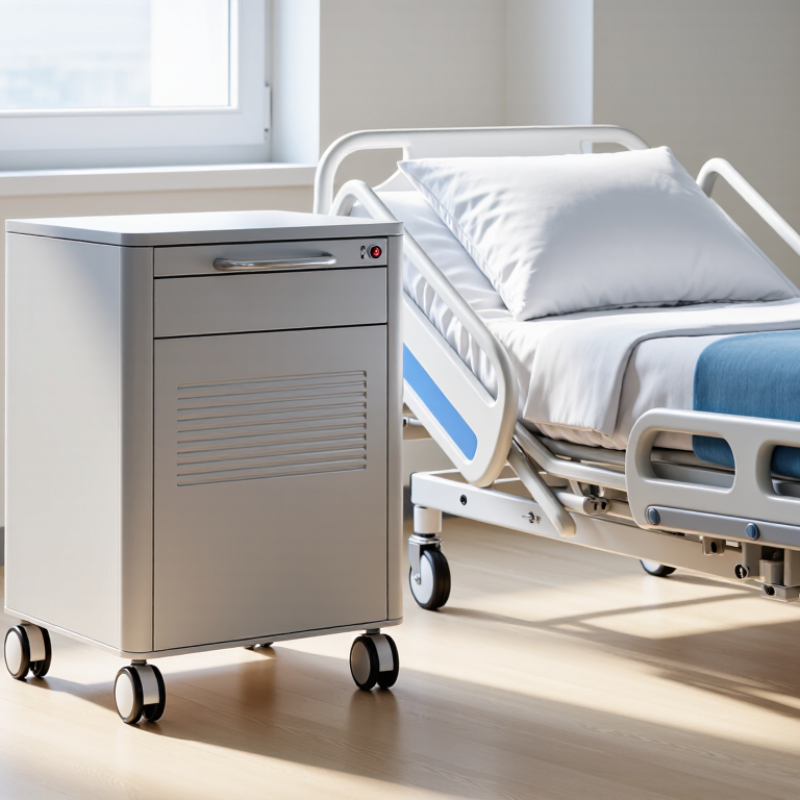
Hospital bedside furniture includes overbed tables, bedside cabinets, drawers, shelves, and integrated mobility supports. These items stay within the patient’s reach, often beside meals, medicines, personal devices, and clinical documents. Their design affects comfort, workflow, cleaning, and patient safety. A useful bedside unit should have smooth, sealed surfaces, rounded edges, stable casters, and handles that work with weak or limited grip.
The infection-control issue is substantial. The World Health Organization reported in 2022 that about 7% of patients in high-income countries and 15% in low- and middle-income countries acquire at least one healthcare-associated infection during acute care.
Patient falls also deserve attention. The Agency for Healthcare Research and Quality estimates that 700,000 to 1 million hospitalized patients fall annually in the United States.
Bedside furniture cannot solve this problem alone. However, fewer seams, hidden fasteners, and clear cleaning instructions can reduce difficult-to-disinfect areas. Small details matter.
Furniture should not block walking paths or create unstable transfer points. Height adjustment, lockable wheels, and accessible storage may support safer movement, but only when staff and patients use them correctly. A beautiful cabinet can still fail in a crowded room.
Supplier evaluation should therefore include material testing, load testing, cleaning trials, and feedback from nurses, cleaners, patients, and maintenance teams. Specifications alone are not enough; actual ward use often reveals uncomfortable handles, noisy wheels, or drawers that open too easily.
A high-quality Chinese hospital bedside furniture supplier should prove performance beyond a polished catalogue. In real ward checks, buyers should inspect drawer alignment, castor movement, edge finishing, and cleaning access. A bedside cabinet must survive repeated wiping, patient transfers, and uneven corridors. Small failures become visible quickly.
Safety documentation matters.
The WHO Global Patient Safety Report 2024 states that one in ten patients experiences harm during healthcare, with more than half considered preventable. Suppliers should therefore provide material declarations, load tests, stability results, and traceable production records. ISO 9001 supports process control, while ISO 13485 may be relevant when products fall within regulated medical-device scopes. Certification alone is not enough. Its scope and certificate validity require verification.
Reliable suppliers also control moisture-resistant panels, low-emission adhesives, and replacement parts. Ask for samples from normal production, not specially prepared prototypes. Factory audits should review incoming inspection, welding checks, packaging tests, and complaint records. The 2023 Logistics Performance Index from the World Bank highlights how customs efficiency, infrastructure, and shipment reliability affect international delivery. A supplier with clear carton dimensions, spare-part coding, and realistic lead times reduces disruption.
Some quotations look excellent until hardware upgrades appear later. That deserves careful questioning. A useful supplier answers technical questions consistently, admits limitations, and records corrective actions. Communication quality is evidence, although not perfect evidence.
China Best Hospital Bedside Furniture Suppliers?
How to Compare China’s Hospital Bedside Furniture Manufacturers
Comparing Chinese manufacturers requires more than checking catalog photos and low prices. Review their production experience, material sources, and quality-control records. Ask whether they produce bedside cabinets for hospitals or mainly serve general furniture markets. The difference matters. Request factory videos, recent inspection reports, and clear production photographs.
Examine the cabinet’s steel thickness, edge treatment, coating quality, drawer movement, and wheel stability. A sample should be tested on uneven flooring and under repeated daily use. Check whether surfaces resist disinfectants, moisture, and common cleaning chemicals. Ask for load ratings and dimensional tolerances. Small gaps can collect dirt. Poor wheels can also create safety concerns.
Communication reveals operational maturity. A reliable supplier should provide detailed drawings, material specifications, packing methods, and realistic lead times. Confirm the minimum order quantity, spare-part policy, and responsibility for defects before placing an order. Sample approval should include color, hardware, measurements, and packaging. Do not rely on verbal promises alone.
Look beyond the first quotation. Compare total landed cost, replacement risks, inspection fees, and delivery reliability. A cheaper cabinet may use thinner panels or weaker hinges. That is easy to miss in a polished presentation. Independent inspection can reduce uncertainty, although it cannot replace a thorough sample review. Some buyers focus too heavily on certificates. Practical testing still matters. Even experienced sourcing teams can overlook noise, odor, or awkward cleaning points. Allow room for correction.
When evaluating China’s best hospital bedside furniture suppliers, buyers should inspect certification details, not just logos on a website. Ask for current ISO 9001 and ISO 13485 certificates when the product falls within medical-device manufacturing. The certificate scope should name the relevant factory and product category. A certificate for office furniture is not enough.
For electrically powered cabinets, tables, or patient-use equipment, request applicable electrical safety and electromagnetic compatibility test reports. Check whether CE marking is required for the destination market, and confirm the supporting technical file. Materials may also need RoHS, REACH, fire-resistance, or low-emission testing. Reports should come from laboratories accredited to ISO/IEC 17025. Verify the report number, testing date, sample description, and factory address.
Quality standards must appear in daily production. Look for incoming material checks, load testing, rounded-edge inspections, coating adhesion tests, and moisture-resistant panel verification. Ask to see batch records and product traceability labels. A practical audit should examine drawer runners, castors, hinges, and cleanability around seams. Small gaps collect disinfectant residue.
Do not rely on photos alone. A supplier may provide excellent samples but inconsistent mass production. Request a pre-shipment inspection and define acceptable defect limits in writing. I have learned that even a valid certificate proves little without factory controls and recent test evidence. Some requirements remain unclear across markets, so buyers should confirm classification with local regulators or qualified technical advisers.
Selecting the right hospital bedside furniture supplier requires more than comparing catalog prices. Start by defining each room’s needs: bed clearance, drawer capacity, infection-control surfaces, mobility, and oxygen-related storage limits. A bedside cabinet should withstand daily cleaning without swollen edges or loose handles. Small details matter.
Request technical drawings, material specifications, load tests, and fire-safety documentation before approval. Verify whether panels resist disinfectants commonly used in your facility. Ask for a working sample, not only photographs. Open the drawers repeatedly. Check wheel brakes, door alignment, sharp edges, and cleaning access.
A supplier with documented quality procedures and relevant medical-furniture experience can answer these questions clearly. Certifications should be checked against the actual product and production site.
Factory evaluation is valuable. Review production capacity, inspection records, packaging methods, and replacement-part control. Ask for references from projects with similar room numbers and delivery conditions. Confirm lead times in writing, including sample approval and shipping buffers. The cheapest offer may conceal weak hardware or expensive repairs. That risk is easy to underestimate.
During procurement, teams sometimes focus too heavily on appearance and forget nighttime noise, caregiver movement, or patient reach. Include nurses, infection-control staff, maintenance personnel, and purchasing specialists in the review. Their feedback may challenge the original specification, which is inconvenient but useful. A reliable supplier should accept revisions, explain limitations, and provide traceable after-sales support rather than making broad promises.
Check drawer alignment, door movement, wheel brakes, edge finishing, and cleaning access. Open each drawer repeatedly. Small faults matter.
Request material declarations, load tests, stability results, fire-safety documents, and traceable production records. Confirm documents match the actual product and factory.
No. Check certificate validity, scope, production site, and covered products. Certification supports evaluation, but it cannot replace physical inspection.
Use a working sample and apply approved cleaning procedures. Inspect panel edges, handles, joints, and corners for swelling or trapped residue.
Review incoming material checks, welding inspections, packaging tests, complaint records, and replacement-part control. Written procedures should match daily practice.
Compare hardware quality, spare parts, carton dimensions, lead times, and repair risks. A low price may hide weak fittings. That is easy to miss.
Include nurses, infection-control staff, maintenance workers, and purchasing specialists. They notice nighttime noise, patient reach, cleaning problems, and difficult movement.
Confirm sample approval dates, production time, shipping buffers, and packaging details in writing. Ask about similar projects and actual delivery conditions.
Reliable suppliers answer technical questions consistently and admit limitations. They record corrective actions and explain after-sales support clearly. Promises alone are weak evidence.
Probably not. Appearance can influence judgment, while hidden hardware problems remain unnoticed. Repeated testing reduces this risk, but teams may still miss something.
Hospital Bedside Furniture is an essential part of modern hospital rooms, supporting patient comfort, caregiver efficiency, and safe daily operations. This article explains how bedside cabinets, overbed tables, and related products contribute to organized care environments. It also outlines the features that distinguish a high-quality Chinese supplier, including durable materials, stable construction, smooth surfaces, easy cleaning, practical storage, flexible configurations, and dependable after-sales support.
Buyers can compare Chinese manufacturers by reviewing production capabilities, customization options, quality-control procedures, delivery capacity, pricing transparency, and communication efficiency. The article also highlights the importance of checking relevant certifications, material safety documentation, testing reports, and quality-management standards before placing an order. Finally, hospitals should select a supplier that understands their project requirements, offers consistent product quality, meets installation and delivery expectations, and can provide reliable long-term cooperation. A careful evaluation process helps buyers balance performance, safety, cost, and service when choosing hospital bedside furniture for different healthcare applications.